
SURINDAR SINGH HARA has been a practicing farmer all his life at his privately owned, self-operated Hara Farms. He has been an agriculture consultant to the F.A.O. of UN and World Bank. Besides holding some important positions in the private & public sectors in India he is one of the pioneers in Northern India Agroforestry.
Hara Farms is a private family farm. Situated 200km north of New Delhi in the state of Haryana near the twin cities of Yamuna Nagar and Jagadhri and is within the area that has witnessed the "green revolution" in wheat and rice.
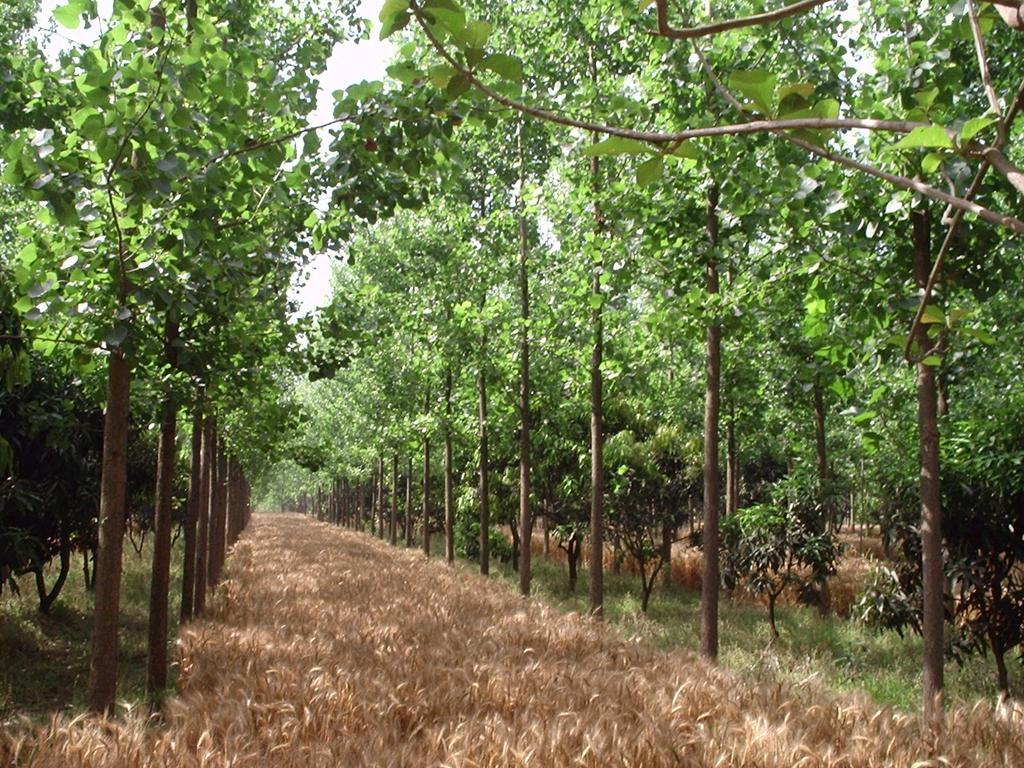
Hara Farms currently grows 20,000 poplar trees, 10,000 eucalyptus trees, 3000 fruit trees (mangos, litchi, sapota) intercropping with wheat, turmeric, ginger, sugarcane, etc. There are also 8 acres under fisheries.
Northern Indian Agro forestry defined as: commercial production of fast growing timber species, exclusively for the wood industry, by small farmers with irrigation, manuring and tree management technology on a harvest cycle of 6-10 years. Crops are grown underneath for yearly cash flow and are agronomically compatible with timber trees for their requirements of irrigation, NPK nutrients and sharing limited sunlight.

Not a single acre was under Agro forestry 25 years ago when two enterprising farmers pioneered this Agroforestry in 1980 it has since flourished through some areas of the northern Indian states of Haryana, western UP and Punjab. First is indifference and ridicule, then is curiosity, skepticism and finally acceptance follows and is what happened in this scenario. Farmers from all over came, saw and replicated what we were doing. We at Hara Farms have encouraged farmers from all over to diversify into agroforestry and give them the recipe of successfully growing trees, guiding them to secure proper plants, nutrition, etc. Perhaps being one of the first to start this agroforestry practice is what has set Hara Farms apart from other producers. Hara Farms is a private entity and it has been our hands on learning experiences that have enabled us to interact with other farmers and encourage their success.
Timber tree growers are very small farmers with holdings ranging from one acre to 50 acres, rarely exceeding 100 acres. The quality and quantity of timber produced varies from farmer to farmer depending on the level of technology adopted, management skills and financial investment of each farmer. Hara Farms has taken the challenge of producing more wood of better quality more economically. Timber yields in excess of 20 tons per acre per year are consistently being produced on a harvest cycle of 10 years. We integrate all essentials of plant growth: superior germ plasm, irrigation, plant nutrition and sunlight adapting new technologies as available.
Agroforestry has also changed the industrial life as well. Today over 15,000 tons of timber logs are marketed daily to feed over 600 wood processing factories, established since 1990, in these three states and mostly concentrated in Jagadhri/Yamuna Nagar. An economy of US $800 million a year has been created which will soon reach one billion and may keep on growing.
So far only two tree species, Poplar and Eucalyptus have become successful. Wood products produced are ply board, wood board, flush doors, high-density board for cement concrete shuttering, packing-cases, and crates, these products are sold throughout India. Tree roots feed furnaces and branches are returned to the soil. A nearby paper mill established 75 years ago, buys 500 tons of waste a day from the wood processing factories. The wood processing factories are small entrepreneurs who started operations with original investments of US $50,000.00 gradually increasing capacities and some have invested up to a million dollars. Their machinery is manufactured locally by entrepreneurial, semi engineers.

Successful Agroforestry Essentials:
Genetic superiority of a tree is a prerequisite. Genetic qualities important in poplars besides wood quality, is its adaptability to our soils and local climate where minimum temperature is around 4 degree Celsius giving selected poplar clones the required dormancy period. Another quality is tree architecture. Trees should accumulate maximum wood in the main tree trunks with small thin branches. Long fat branches rob the trunk of wood and form undesirable knots that lowers log value. Poplar trees growing straight to 30 meters height with least spread allows for greater density of trees. Poplar trees are pruned every year to ensure one leader at top – a few potential fat branches are pruned before they rob the trunk of wood. Lower branches that do not get sunlight are pruned before they form undesirable knots. Eucalyptus clones are self pruning, the main trunk has about 3 meters of straight canopy thus allowing an even higher density of trees. Most importantly selected clones must respond favorably to increasing amounts of irrigation, manuring and tree management. Seed reproduced plants are rarely true to their parent tree characteristics and are unsuitable for our Agroforestry, therefore selected tree clones are multiplied vegetatively. Poplars are reproduced through cuttings but eucalyptus must be cloned and produced by plant breeding scientists with expensive infrastructure.
Plant Nutrition: Over 20 tons of timber with intercropping requires substantial plant nutrition to produce 25-30 tons of biomass per acre per year. We have determined NPK and micro nutrient requirements and prefer organic manures in the form of dairy, worm culture and other bio manures for long term health of our soils.

Sunlight: Sunlight can not be increased, unlike other factors, optimal use of sunlight is vital. We have determined that 200 poplars and 400 eucalyptus trees per acre is ideal. Distance is increased between tree lines and reduced between trees, the rows run north-south to give maximum sunlight to each tree.
Our high-input-high-output Agroforestry is sustainable, agronomically compatible, ecologically safe, environmentally useful and economically attractive for all.
Visitors are impressed with the timber quality, yields, uniformity in growth and the production of high value intercropping adds to the appeal of our agroforestry. Visitors are also convinced that the timber needs of the 21st Century will increasingly come from such agroforestry and less from natural forests. In developing and developed countries, tropical or temperate climates regions timber production in natural forests varies between one to five tons of timber per acre per year on a 100-200 year cycle. Hara Farms produces 20 tons timber per acre per year on 10 year cycle. Agroforestry can be established around pollution creating centers of urban development and industrial complexes. Worldwide awareness and concern of environmental degradation, pollution, climate change etc. are recognized as a result of two factors: unprecedented fossil fuel burning and unprecedented forest destruction, witnessed in the last few decades. Both can not be stopped for strong economic reasons.
Our economically attractive and environmentally desirable agroforestry is the best example and perhaps the only viable solution of impending ecological and climatic disaster. This success story needs to be replicated with other timber tree species of diversified wood quality and for diversified climates of the world. The developed countries of the world have ample research and development resources to make this type of agroforestry a success, only awareness is needed.
This unique success story is efforts in the private sector with minimal research and development resources. Our Government so far has not contributed to the success story of agroforestry, but they do recognize it and bring teams of students, farmers, foresters and delegations from around the world.
You may contact us at the following address:
Not a single acre was under Agro forestry 25 years ago when two enterprising farmers pioneered this Agroforestry in 1980 it has since flourished through some areas of the northern Indian states of Haryana, western UP and Punjab. First is indifference and ridicule, then is curiosity, skepticism and finally acceptance follows and is what happened in this scenario. Farmers from all over came, saw and replicated what we were doing. We at Hara Farms have encouraged farmers from all over to diversify into agroforestry and give them the recipe of successfully growing trees, guiding them to secure proper plants, nutrition, etc. Perhaps being one of the first to start this agroforestry practice is what has set Hara Farms apart from other producers. Hara Farms is a private entity and it has been our hands on learning experiences that have enabled us to interact with other farmers and encourage their success.
Timber tree growers are very small farmers with holdings ranging from one acre to 50 acres, rarely exceeding 100 acres. The quality and quantity of timber produced varies from farmer to farmer depending on the level of technology adopted, management skills and financial investment of each farmer. Hara Farms has taken the challenge of producing more wood of better quality more economically. Timber yields in excess of 20 tons per acre per year are consistently being produced on a harvest cycle of 10 years. We integrate all essentials of plant growth: superior germ plasm, irrigation, plant nutrition and sunlight adapting new technologies as available.
Agroforestry has also changed the industrial life as well. Today over 15,000 tons of timber logs are marketed daily to feed over 600 wood processing factories, established since 1990, in these three states and mostly concentrated in Jagadhri/Yamuna Nagar. An economy of US $800 million a year has been created which will soon reach one billion and may keep on growing.
So far only two tree species, Poplar and Eucalyptus have become successful. Wood products produced are ply board, wood board, flush doors, high-density board for cement concrete shuttering, packing-cases, and crates, these products are sold throughout India. Tree roots feed furnaces and branches are returned to the soil. A nearby paper mill established 75 years ago, buys 500 tons of waste a day from the wood processing factories. The wood processing factories are small entrepreneurs who started operations with original investments of US $50,000.00 gradually increasing capacities and some have invested up to a million dollars. Their machinery is manufactured locally by entrepreneurial, semi engineers.

Successful Agroforestry Essentials:
Genetic superiority of a tree is a prerequisite. Genetic qualities important in poplars besides wood quality, is its adaptability to our soils and local climate where minimum temperature is around 4 degree Celsius giving selected poplar clones the required dormancy period. Another quality is tree architecture. Trees should accumulate maximum wood in the main tree trunks with small thin branches. Long fat branches rob the trunk of wood and form undesirable knots that lowers log value. Poplar trees growing straight to 30 meters height with least spread allows for greater density of trees. Poplar trees are pruned every year to ensure one leader at top – a few potential fat branches are pruned before they rob the trunk of wood. Lower branches that do not get sunlight are pruned before they form undesirable knots. Eucalyptus clones are self pruning, the main trunk has about 3 meters of straight canopy thus allowing an even higher density of trees. Most importantly selected clones must respond favorably to increasing amounts of irrigation, manuring and tree management. Seed reproduced plants are rarely true to their parent tree characteristics and are unsuitable for our Agroforestry, therefore selected tree clones are multiplied vegetatively. Poplars are reproduced through cuttings but eucalyptus must be cloned and produced by plant breeding scientists with expensive infrastructure.
Plant Nutrition: Over 20 tons of timber with intercropping requires substantial plant nutrition to produce 25-30 tons of biomass per acre per year. We have determined NPK and micro nutrient requirements and prefer organic manures in the form of dairy, worm culture and other bio manures for long term health of our soils.

Sunlight: Sunlight can not be increased, unlike other factors, optimal use of sunlight is vital. We have determined that 200 poplars and 400 eucalyptus trees per acre is ideal. Distance is increased between tree lines and reduced between trees, the rows run north-south to give maximum sunlight to each tree.
Our high-input-high-output Agroforestry is sustainable, agronomically compatible, ecologically safe, environmentally useful and economically attractive for all.
Visitors are impressed with the timber quality, yields, uniformity in growth and the production of high value intercropping adds to the appeal of our agroforestry. Visitors are also convinced that the timber needs of the 21st Century will increasingly come from such agroforestry and less from natural forests. In developing and developed countries, tropical or temperate climates regions timber production in natural forests varies between one to five tons of timber per acre per year on a 100-200 year cycle. Hara Farms produces 20 tons timber per acre per year on 10 year cycle. Agroforestry can be established around pollution creating centers of urban development and industrial complexes. Worldwide awareness and concern of environmental degradation, pollution, climate change etc. are recognized as a result of two factors: unprecedented fossil fuel burning and unprecedented forest destruction, witnessed in the last few decades. Both can not be stopped for strong economic reasons.
Our economically attractive and environmentally desirable agroforestry is the best example and perhaps the only viable solution of impending ecological and climatic disaster. This success story needs to be replicated with other timber tree species of diversified wood quality and for diversified climates of the world. The developed countries of the world have ample research and development resources to make this type of agroforestry a success, only awareness is needed.
This unique success story is efforts in the private sector with minimal research and development resources. Our Government so far has not contributed to the success story of agroforestry, but they do recognize it and bring teams of students, farmers, foresters and delegations from around the world.
You may contact us at the following address:
Surindar Singh Hara
C/o Hara Farms, P.O. Amadalpur, Jagadhri, Haryana 135101, India
Tel.: 91-01732-271444/309269
Cell: 91-9355533444
E-mail: harafarms@gmail.com
C/o Hara Farms, P.O. Amadalpur, Jagadhri, Haryana 135101, India
Tel.: 91-01732-271444/309269
Cell: 91-9355533444
E-mail: harafarms@gmail.com
posted by Hara Farms @ 8:00 AM
2 comments

